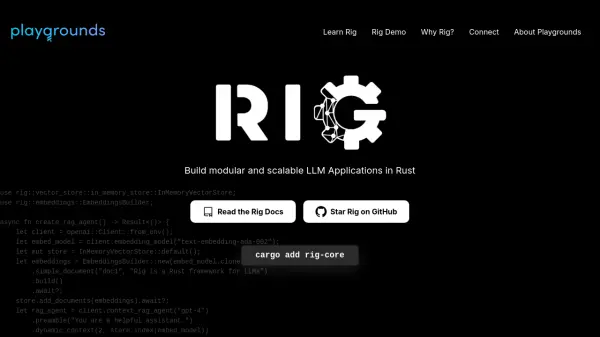
Rig favicon

Rig
Build Modular and Scalable LLM Applications in Rust

What is Rig?

Rig is a framework designed for building modular and scalable Large Language Model (LLM) applications using the Rust programming language. It provides developers with a unified API to access different LLM providers, simplifying integration and reducing the risk of vendor lock-in.

Rig takes full advantage of Rust's performance features, including zero-cost abstractions and memory safety, enabling high-performance LLM operations. The framework also includes pre-built, modular components for implementing complex AI systems, such as Retrieval-Augmented Generation (RAG) and multi-agent setups. Rig ensures robust and reliable LLM interactions through the application of Rust's strong type system, which provides compile-time correctness.

Features

  • Unified LLM Interface: Consistent API across different LLM providers, simplifying integration and reducing vendor lock-in.
  • Rust-Powered Performance: Leverage Rust's zero-cost abstractions and memory safety for high-performance LLM operations.
  • Advanced AI Workflow Abstractions: Implement complex AI systems like RAG and multi-agent setups with pre-built, modular components.
  • Type-Safe LLM Interactions: Utilize Rust's strong type system to ensure compile-time correctness in LLM interactions.
  • Seamless Vector Store Integration: Built-in support for vector stores, enabling efficient similarity search and retrieval for AI applications.
  • Flexible Embedding Support: Easy-to-use APIs for working with embeddings, crucial for semantic search and content-based recommendations.

Use Cases

  • Building LLM applications requiring high performance and scalability.
  • Implementing complex AI systems such as RAG and multi-agent setups.
  • Developing applications that require efficient similarity search and retrieval.
  • Creating applications needing semantic search and content-based recommendations.
Related Tools:

Blogs:

  • Top 6 AI note-taking tools for 2026: in-person, online, and hybrid use cases

    Top 6 AI note-taking tools for 2026: in-person, online, and hybrid use cases

    Most AI note-taking lists are really lists of meeting bots, which join your video call and transcribe it. That's useful, but it's half the picture. Decisions happen in hallway conversations, client dinners, on-site visits, and hybrid rooms where nobody is on a video link. This guide covers different parts of the note-taking workflow: hardware capture for in-person settings, platform-native tools for online calls, and AI layers for organizing and synthesizing what you've captured. It compares six tools by capture context, workflow fit, pricing, and limitations.

  • Best AI tools for Lawyers

    Best AI tools for Lawyers

    streamline legal processes, enhance research capabilities, and improve overall efficiency in the legal profession.

  • Top AI tools for Teachers

    Top AI tools for Teachers

    Explore the top AI tools designed for teachers, revolutionizing the education landscape. These innovative tools leverage artificial intelligence to enhance teaching efficiency, personalize learning experiences, automate administrative tasks, and provide valuable insights, empowering educators to create engaging and effective educational environments.

  • Boost Engagement in Ads with AI

    Boost Engagement in Ads with AI

    Discover how AI music and AI SDR agents are reshaping modern advertising. Learn how emotional resonance through AI-generated soundtracks combined with smart, automated sales outreach can turn viewers into loyal customers faster, cheaper, and more personally than ever before.

Didn't find tool you were looking for?

Be as detailed as possible for better results