What is Orby AI?
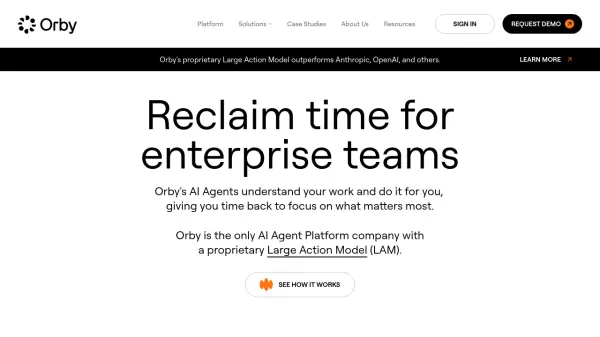
Orby AI is an enterprise-grade AI Agent Platform designed to automate complex workflows. It leverages a proprietary Large Action Model (LAM) that surpasses existing solutions like those from Anthropic and OpenAI. This enables Orby AI to understand the context and intent behind processes, providing unprecedented flexibility and resilience in automation.
Unlike traditional automation tools that rely on rigid rules, Orby AI observes, learns, and adapts to workflows, including application and UI changes. This Generative Process Automation (GPA) approach minimizes breaks, lowers maintenance costs, and increases efficiency, ultimately allowing enterprise teams to focus on higher-value tasks.
Features
- Large Action Model (LAM): Outperforms existing models in understanding context and intent.
- Generative Process Automation (GPA): Automates workflows of any complexity without rigid rules.
- Self-Learning Capability: Adapts to application/UI changes and user feedback, reducing maintenance.
- Workflow Observation: Seamlessly observes user actions across multiple tabs and applications.
- Intelligent Decision Making: Understands context, reasons, and makes decisions like an experienced team member.
Use Cases
- Automate financial close processes.
- Streamline vendor management.
- Automate reconciliations.
- Streamline audit preparation.
- Manage workflows across departments.