What is Nitrode?
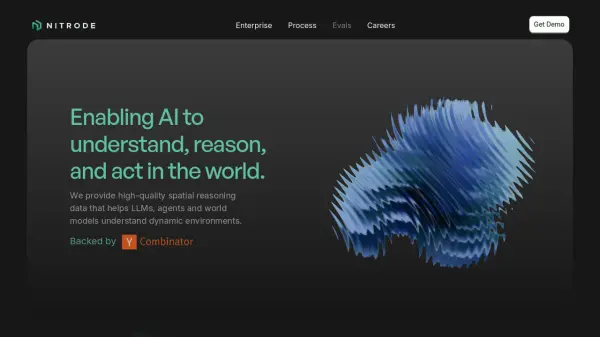
Nitrode specializes in providing high-quality spatial reasoning data designed to enhance the capabilities of large language models, agents, and world models. The platform focuses on enabling artificial intelligence systems to understand, reason, and act within dynamic environments by offering detailed datasets that capture world dynamics.
The company builds small, fully specified environments that expose ground-truth state, transitions, and events over time, including information that models cannot directly observe. This approach allows researchers to train and evaluate models on critical aspects such as memory, causality, and prediction, moving beyond simple outcome-based assessments to foster deeper AI understanding of spatial and temporal reasoning.
Features
- Spatial Reasoning Data: High-quality datasets for LLMs, agents, and world models
- Fully Specified Environments: Small environments designed to surface world dynamics
- Ground-Truth Exposure: Provides state, transitions, and events over time, including unobservable information
- Model Training Focus: Enables training on memory, causality, and prediction
- Research Support: Works with research teams on spatial and temporal reasoning projects
Use Cases
- Training LLMs on spatial reasoning
- Developing AI agents for dynamic environments
- Building world models with enhanced understanding
- Researching memory and causality in AI systems
- Evaluating prediction capabilities in AI models
FAQs
-
What kind of data does Nitrode provide?
Nitrode provides high-quality spatial reasoning data for LLMs, agents, and world models, including ground-truth state, transitions, and events from fully specified environments. -
What is spatial reasoning data for foundational models?
Spatial reasoning data helps foundational models understand dynamic environments by exposing world dynamics, enabling training on memory, causality, and prediction. -
How is this different from standard datasets?
Unlike standard datasets that focus on what to say or do, Nitrode's environments surface world dynamics with ground-truth information, including unobservable details, for deeper model training. -
Are datasets off-the-shelf or custom?
Nitrode works with research teams to provide tailored solutions; specific details on off-the-shelf vs. custom datasets are not specified, but customization is implied through collaboration. -
What outcomes can enterprises expect?
Enterprises can expect enhanced AI models with improved understanding of dynamic environments, better spatial and temporal reasoning, and capabilities in memory, causality, and prediction.