What is LLM Explorer?
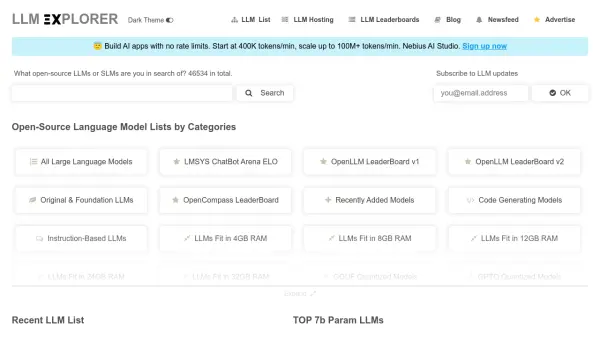
LLM Explorer serves as a vital resource for AI and Machine Learning professionals, offering access to an extensive database of over 46,000 open-source language models. The platform provides a structured environment for users to explore both Large Language Models (LLMs) and Small Language Models (SLMs), facilitating the discovery of the latest advancements in AI language technology.
Featuring intuitive categorization, powerful search capabilities, and integrated leaderboards (like LMSYS ChatBot Arena, OpenLLM, OpenCompass), LLM Explorer simplifies the process of finding suitable models. Users can filter models based on various criteria, including hardware requirements (VRAM), quantization types (GGUF, GPTQ, EXL2), use cases (code generation, instruction-based), licensing (commercial use), and performance benchmarks, making it an essential tool for researchers, developers, and AI enthusiasts navigating the dynamic landscape of language models.
Features
- Extensive Model Database: Access to over 46,534 open-source LLMs and SLMs.
- Advanced Categorization: Filter models by VRAM requirements, quantization type, fine-tuning status, commercial use, context size, and more.
- Integrated Leaderboards: View rankings from LMSYS ChatBot Arena, OpenLLM, and OpenCompass.
- Benchmark Data: Compare models based on various performance metrics (MMLU, GPQA, MATH, HumanEval, etc.).
- Search Functionality: Easily find specific models or types of models.
- Regular Updates: Keeps track of recently added and updated models.
- Quantization Information: Identifies models quantized using GGUF, GPTQ, EXL2 formats.
Use Cases
- Discovering open-source LLMs/SLMs for specific AI projects.
- Comparing language model performance using benchmark data and leaderboards.
- Finding models compatible with specific hardware constraints (e.g., limited VRAM).
- Identifying models suitable for commercial applications.
- Staying updated on the latest releases and advancements in language models.
- Researching code-generating or instruction-following models.
- Exploring different quantized versions of popular models.