What is LemonadeJS?
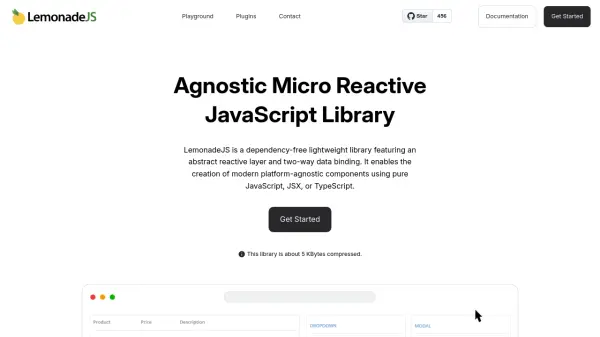
LemonadeJS is a micro reactive JavaScript library designed for modern web development, featuring a lightweight architecture of about 5 KB compressed. It provides an abstract reactive layer with two-way data binding, enabling seamless synchronization between component properties and HTML elements. The library supports development in pure JavaScript, JSX, or TypeScript, allowing flexibility without dependencies or transpiling requirements.
Built for efficiency and clarity, LemonadeJS integrates with popular frameworks like Vue, React, and Angular while maintaining framework-agnostic compatibility. It includes components such as data grids, modals, calendars, and dropdowns, along with a Sugar communication system for global state management using a pub/sub pattern. The library emphasizes performance, speed, and developer control, making it suitable for rapid prototyping and production applications.
Features
- Two-way Data Binding: Synchronizes changes between component properties and HTML elements using the :bind directive
- Lightweight Architecture: Compressed package of about 5 KB for improved load performance
- Framework Agnostic: Integrates with Vue, React, and Angular without altering existing architecture
- Sugar Communication System: Enables global data sharing and actions using a pub/sub pattern with set and dispatch methods
- Component Library: Includes reusable components like data grids, modals, calendars, and dropdowns for building interfaces
Use Cases
- Building reactive web applications with two-way data binding
- Creating platform-agnostic components using JavaScript, JSX, or TypeScript
- Integrating lightweight libraries into existing Vue, React, or Angular projects
- Developing data-intensive interfaces with features like search, filter, and pagination
- Rapid prototyping of web applications without dependencies or transpiling