What is Labml Neural Networks?
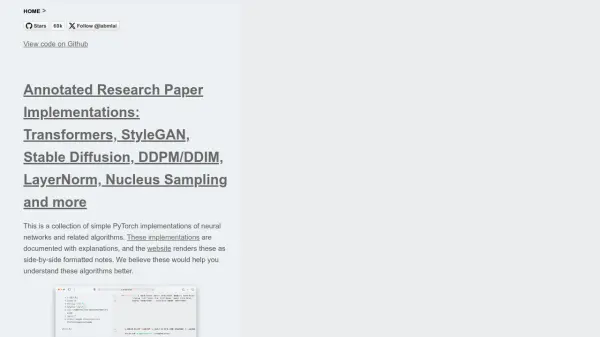
Labml Neural Networks provides a curated collection of straightforward PyTorch implementations focusing on key neural networks and related algorithms. The primary goal of this resource is to facilitate a deeper understanding of these complex concepts through clear, documented code.
Each implementation is accompanied by detailed explanations presented side-by-side with the code, making it easier to follow the logic and grasp the underlying principles. The repository covers a wide range of modern AI architectures and techniques, serving as a valuable educational and practical resource for developers and researchers in the field of artificial intelligence.
Features
- Annotated Implementations: PyTorch code presented with side-by-side explanatory notes.
- Extensive Model Coverage: Includes implementations for Transformers (GPT, ViT, RoPE, ALiBi), Diffusion Models (DDPM, DDIM, Stable Diffusion), GANs (StyleGAN2, CycleGAN), LSTMs, ResNet, GNNs, and more.
- Algorithm Explanations: Details various algorithms including optimizers (Adam, Noam, Sophia-G), normalization layers (LayerNorm, Batch Norm, DeepNorm), and sampling techniques (Nucleus, Top-k).
- Focus on Clarity: Designed specifically to help users learn and understand complex neural network concepts.
- Active Maintenance: The repository is regularly updated with new implementations.
Use Cases
- Learning and understanding complex neural network architectures.
- Implementing research papers in PyTorch.
- Experimenting with different AI models and algorithms.
- Finding reference implementations for AI research and development.
- Serving as an educational resource for AI and deep learning students and practitioners.