What is Kestra?
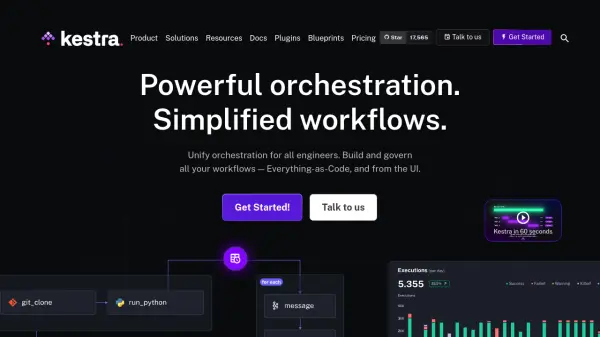
Kestra is a versatile orchestration platform enabling users to build, run, schedule, and monitor complex workflows efficiently. It offers a unified solution for various engineering disciplines, including data, software, and platform engineering, promoting collaboration through its dual interface that supports both coding and a user-friendly UI. The platform's declarative nature, defined using YAML, simplifies workflow creation and maintenance, making it accessible even for team members with varying technical backgrounds.
Kestra is designed to be language-agnostic, separating business logic from orchestration logic, allowing integration with scripts written in Python, R, Java, Julia, Ruby, and more. It supports deployment across diverse environments, including on-premise, hybrid, or any cloud infrastructure, without complex dependencies. Its event-driven capabilities allow workflows to be triggered by schedules, webhooks, APIs, or real-time events, providing flexibility for various automation needs, from data pipelines and microservices to business processes and infrastructure provisioning.
Kestra is designed to be language-agnostic, separating business logic from orchestration logic, allowing integration with scripts written in Python, R, Java, Julia, Ruby, and more. It supports deployment across diverse environments, including on-premise, hybrid, or any cloud infrastructure, without complex dependencies. Its event-driven capabilities allow workflows to be triggered by schedules, webhooks, APIs, or real-time events, providing flexibility for various automation needs, from data pipelines and microservices to business processes and infrastructure provisioning.
Features
- Declarative Orchestration: Define workflows using simple YAML syntax for easy maintenance and onboarding.
- UI & Code Interface: Build and manage workflows through both a visual UI and an embedded code editor, synchronized for collaboration.
- Language Agnostic: Separate orchestration logic from business logic written in Python, R, Java, Julia, Ruby, etc.
- Event-Based Triggers: Trigger workflows via schedules, webhooks, APIs, or real-time events.
- Deploy Anywhere: Run on-prem, hybrid, or any cloud environment without complex dependencies.
- Extensive Plugin Library: Integrate with various third-party systems, data sources, and applications using over 600 plugins.
- CI/CD Integration: Manage workflows like code with version control and CI/CD practices using the Terraform Provider.
- Scalability: Built for handling complex workflows and scaling infrastructure on-demand.
- Blueprints: Utilize ready-made workflow templates (250+) to accelerate development.
Use Cases
- Orchestrate data pipelines for ETL/ELT processes.
- Automate business processes across different systems.
- Manage and deploy microservices.
- Automate infrastructure provisioning and operations.
- Build and manage ML/AI workflows.
- Implement event-driven automation based on real-time triggers.
- Streamline CI/CD processes for workflows.
FAQs
-
Is it easy to upgrade from Open Source edition to Kestra Enterprise?
Yes, it requires adding the license key to the configuration file and restarting the server. -
Does the Enterprise Edition come with Enterprise Support and SLAs?
Yes, the Enterprise Edition includes access to an exclusive customer portal, end-to-end customer onboarding, guaranteed response times on support requests, and operates within a full Customer Success Framework. -
Is Kestra Enterprise suitable for small teams?
Kestra Enterprise is designed for any organization or professional needing to secure production workloads with high-security standards and enterprise support, regardless of team size. -
How does Kestra handle business logic in different languages?
Kestra is language-agnostic, separating orchestration logic from business logic, allowing users to run scripts and code written in various languages like Python, R, Java, Julia, Ruby, etc., as part of the workflows. -
Can Kestra workflows be triggered by events?
Yes, workflows can be configured to run based on schedules, webhooks, APIs, or event-based triggers, supporting real-time processing.