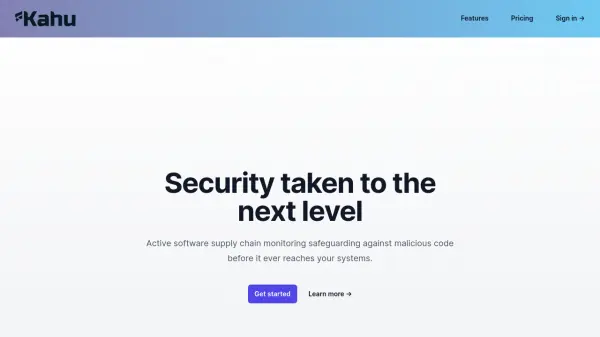
What is Kahu?
Kahu offers active software supply chain monitoring to protect applications from malicious code hidden in third-party dependencies. It provides real-time visibility into your software supply chain by scanning and analyzing every line of dependency code to identify malicious behavior, security risks, and hidden vulnerabilities. With advanced algorithms and comprehensive scanning, Kahu uncovers potential backdoors and ensures the integrity of your applications. The tool delivers detailed reports and actionable insights, alerting you to suspicious activities so you can take proactive measures. It also helps maintain compliance with security standards by continuously monitoring dependencies for compliance issues. Integration is seamless with popular development tools and pipelines, fortifying your supply chain without disrupting workflows. Kahu leverages machine learning and threat intelligence to stay ahead of emerging threats, updating its knowledge base to recognize the latest attack vectors.
Features
- Real-Time Monitoring: Continuously scans and analyzes third-party dependency code for malicious behavior and security risks.
- Hidden Vulnerability Detection: Uncover hidden vulnerabilities and potential backdoors using advanced algorithms and comprehensive scanning.
- Actionable Insights: Provides detailed reports and alerts about suspicious activities and security risks.
- Compliance Monitoring: Continuously monitors dependencies for compliance with security standards and regulations.
- Seamless Integration: Integrates with CI/CD pipelines, GitHub Actions, and command-line interface without disrupting workflows.
- Threat Intelligence: Leverages machine learning and threat intelligence to stay updated on emerging threats.
Use Cases
- Protect applications from supply chain attacks by detecting malicious code in open-source dependencies.
- Identify hidden vulnerabilities and backdoors in third-party packages before deployment.
- Ensure compliance with security standards like SOC 2 or ISO 27001 by monitoring dependency security.
- Monitor and secure CI/CD pipelines against compromised packages.
- Generate security reports for audits and risk assessments.
FAQs
-
What is a dashboard seat?
A dashboard seat is the access to Kahu's dashboard. The number of seats represents the number of users that can be registered to access the dashboard. -
What is a code committer?
A code committer is a user who made a commit to a monitored repository in the past 30 days. -
Do I have to share private source code with Kahu?
No. Kahu only needs access to the metadata stored on a lockfile. -
How are the number of unique dependencies measured?
If two or more monitored projects require the same package (e.g., monolog/monolog) as a direct or transitive dependency, it will be counted a single time towards the account limit.