What is illumex?
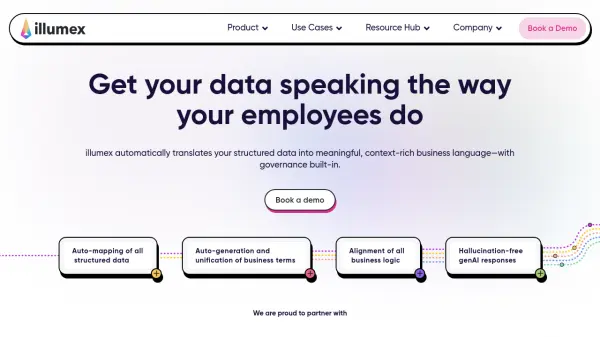
illumex provides a Generative Semantic Fabric (GSF) platform that automatically transforms structured data into meaningful, context-rich business language. This process involves auto-mapping all structured data, auto-generating and unifying business terms, and aligning all business logic, ensuring governance is built-in.
By accessing metadata without moving it from its sources, illumex offers effortless data discovery, labeling, and mapping. The platform ensures hallucination-free responses from GenAI agents and provides augmented governance for a single source of truth, making it ideal for heavily regulated industries.
Features
- Auto-mapping of all structured data: Automatically discovers and labels structured data without moving it from its sources.
- Auto-generation and unification of business terms: Creates a Business Glossary with auto-generated terms, definitions, and metrics.
- Alignment of all business logic: Flags duplications, errors, and PII while reconciling structured data.
- Hallucination-free genAI responses: Guarantees deterministic answers from an organizational semantic knowledge graph.
- Augmented AI Governance: Provides a single source of truth with automated documentation and classification.
- Effortless Data Discovery: Automatically discovers, labels and adds meaning to your data.
Use Cases
- Enterprise Chatbot
- Data Products Repository
- Augmented D&A Governance
- D&A Activities Metrics
- Semantic AI-enabled Data Fabric
- Data Operations (DataOps)
- Active Metadata Management
FAQs
-
What is a generative semantic fabric?
illumex's Generative Semantic Fabric (GSF) is an automated knowledge graph of semantic embeddings created from your organizational metadata and industry knowledge, combined with business logic—and with governance built-in. GSF transforms intricate data structures and siloed business logic into a format that's easy for BI tools and large language models (LLMs) to understand. -
How is illumex different from RAG (Retrieval-Augmented Generation)?
RAG requires manual maintenance, while illumex is maintained automatically. RAG doesn't guarantee a single source of truth, while illumex does. RAG needs security and governance on top of it, illumex comes with security and governance already built-in. RAG is significantly more expensive than illumex. -
Is illumex really automated?
Absolutely! illumex is the only platform that automatically translates your structured data into natural, context-rich business language. From the moment you onboard, illumex's proprietary data engine is ready to go—as it's pre-trained on our business ontologies, tailored to your specific domain. -
How is governance built-in?
illumex facilitates augmented governance certification workflows on top of auto-generated documentation, classification, and tagging. This ensures all your organization’s structured data, analytics, AI, and genAI interactions are documented, certified, trackable, and explainable. -
Is illumex secure?
Yes! illumex is SOC2, GDPR, and ISO 27001 compliant. What’s more, illumex only ever touches metadata—not the values of your data—and never moves data from its original sources.