What is dbdocs?
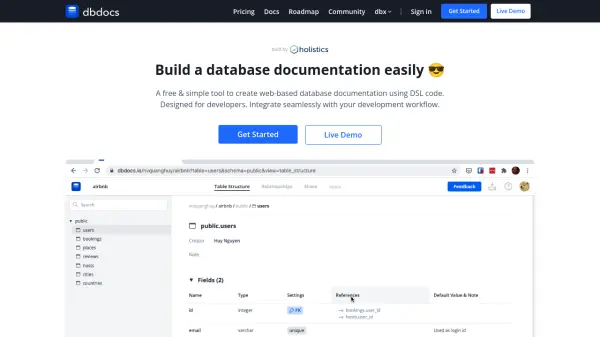
dbdocs offers a cloud-based solution for generating comprehensive database documentation directly from code, utilizing the open-source DBML (Database Markup Language) standard. Designed for seamless integration with development processes, dbdocs allows users to define, version, and maintain database schemas collaboratively, ensuring consistency and clear communication across teams.
The platform supports password-protected sharing, customizable access controls, embedded documentation views, and visual relationship mapping among tables. Enhanced visualization features such as color-coded table headers, sticky notes, and schema changelog history empower teams to easily onboard, manage, and hand off database projects with clarity and ease.
Features
- DBML-Based Schema Definition: Define database documentation using the open-source DBML language.
- Cloud-Hosted Documentation: Access, share, and manage database docs online.
- Secure & Collaborative Sharing: Password protection, private mode, and invitation-based collaboration.
- Embedded Documentation Views: Integrate documentation into external platforms such as Notion or Confluence.
- Visual Relationship Mapping: Visualize table relationships and metadata for improved understanding.
- CI/CD and Git Integration: Incorporate documentation updates into DevOps pipelines and version control.
- Schema Changelog History: Review, compare, and manage all schema changes with unlimited version history.
- Custom Visualization: Table groupings, header colors, diagram detail toggling, and sticky notes.
- Team Management: Unified workspace, member roles, and centralized admin and billing controls.
- Self-Hosted Option Available: Support for enterprise-level security requirements with private deployments.
Use Cases
- Onboarding developers quickly with clear, visual database documentation.
- Sharing secure database documentation with internal teams or external stakeholders.
- Integrating up-to-date schema documentation into CI/CD pipelines.
- Collaboratively managing and reviewing schema changes during development cycles.
- Embedding live database documentation within knowledge bases or project management platforms.
- Simplifying database handovers between software agencies and clients.
- Supporting data governance strategies with living documentation.
FAQs
-
What markup language does dbdocs use for documentation?
dbdocs uses DBML (Database Markup Language), an open-source DSL for defining and documenting database structures. -
Can I make my dbdocs project private?
Yes, projects can be made private with access restricted to invited users and password protection options. -
Is a self-hosted version of dbdocs available?
Yes, organizations with strict security requirements can request a self-hosted deployment by contacting the dbdocs team. -
Does dbdocs support team management and collaboration?
Yes, dbdocs offers collaborative workspaces, team management, and unified billing and administration for teams. -
Can I embed dbdocs into other platforms?
Yes, you can embed documentation into platforms like Notion, Confluence, Miro, or your own website through embedded views.