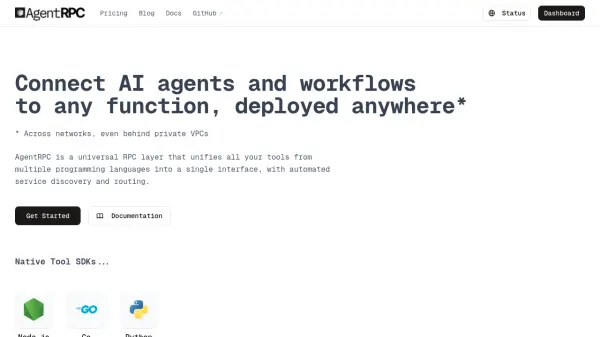
What is AgentRPC?
AgentRPC serves as a universal Remote Procedure Call (RPC) layer, streamlining the integration of AI agents and workflows with functions deployed across diverse environments. It enables developers to connect their AI agents to tools written in various programming languages, such as Node.js and Go, through a unified interface. This system automates service discovery and routing, simplifying the process of extending AI capabilities.
A key capability of AgentRPC is its support for functions hosted within private networks or VPCs, eliminating the need to expose these services publicly. It utilizes long polling SDKs, allowing AI agents to interact with long-running functions that exceed standard HTTP timeout limits. The platform also incorporates features like automatic failover and retries for enhanced reliability, along with comprehensive observability tools including tracing, metrics, and event logging for monitoring tool performance and health.
Features
- Universal RPC Layer: Unifies tools from multiple languages into a single interface.
- Multi-language Support: Connects agents to tools written in TypeScript and Go (with .Net coming soon).
- Private Network Support: Enables registration and access of functions within private VPCs without opening ports.
- Long-running Functions: Supports asynchronous calls to functions exceeding standard HTTP timeout limits via long polling.
- Full Observability: Offers tracing, metrics, and events through a hosted platform for monitoring.
- Automatic Failover & Retries: Manages function health and automatically handles failures.
- Framework Compatibility: Natively supports MCP and OpenAI SDK compatible agents.
- Automated Service Discovery & Routing: Automatically finds and directs tool calls.
Use Cases
- Integrating AI agents with tools hosted in private networks or VPCs.
- Building complex LLM automations that require interaction with external functions.
- Connecting AI agents to APIs or processes that take longer than standard timeouts.
- Managing and monitoring tool calls for AI agents operating in distributed systems.
- Simplifying the integration of tools written in different programming languages for AI applications.
FAQs
-
Why would I want to use AgentRPC?
AgentRPC allows AI agents or LLM automations to call tools hosted on different services, even within private VPCs, without needing to expose the service publicly or build custom integrations. It provides a ready-made solution with native SDKs and OpenAI-SDK compatible tool definitions. -
How does AgentRPC work?
When a tool is registered using the AgentRPC SDK, it connects to api.agentrpc.com. The SDK then periodically polls for new calls. When an agent initiates a call, AgentRPC detects it during the polling check and executes the corresponding tool. -
What advantages does AgentRPC offer compared to standard HTTP APIs?
AgentRPC eliminates the need to build custom APIs and service discovery mechanisms. It supports long-running tools via async polling, unlike timeout-limited HTTP APIs. It also co-locates tool definitions with functions and provides benefits like caching and automatic retries. -
Is AgentRPC a managed service or an SDK?
AgentRPC is primarily a managed service provider offering a hosted platform with observability features (tracing, metrics, events), complemented by a set of SDKs for tool registration and consumption. -
Where are the tools executed when using AgentRPC?
Tools are executed on your own infrastructure. AgentRPC acts as middleware, facilitating communication between your AI agent and the functions running on your systems. -
How can AgentRPC connect to services behind a firewall or in a private network?
Registered tools use a long polling mechanism to periodically check api.agentrpc.com for calls. This outbound connection means no incoming ports need to be opened or firewalls configured for AgentRPC to function.