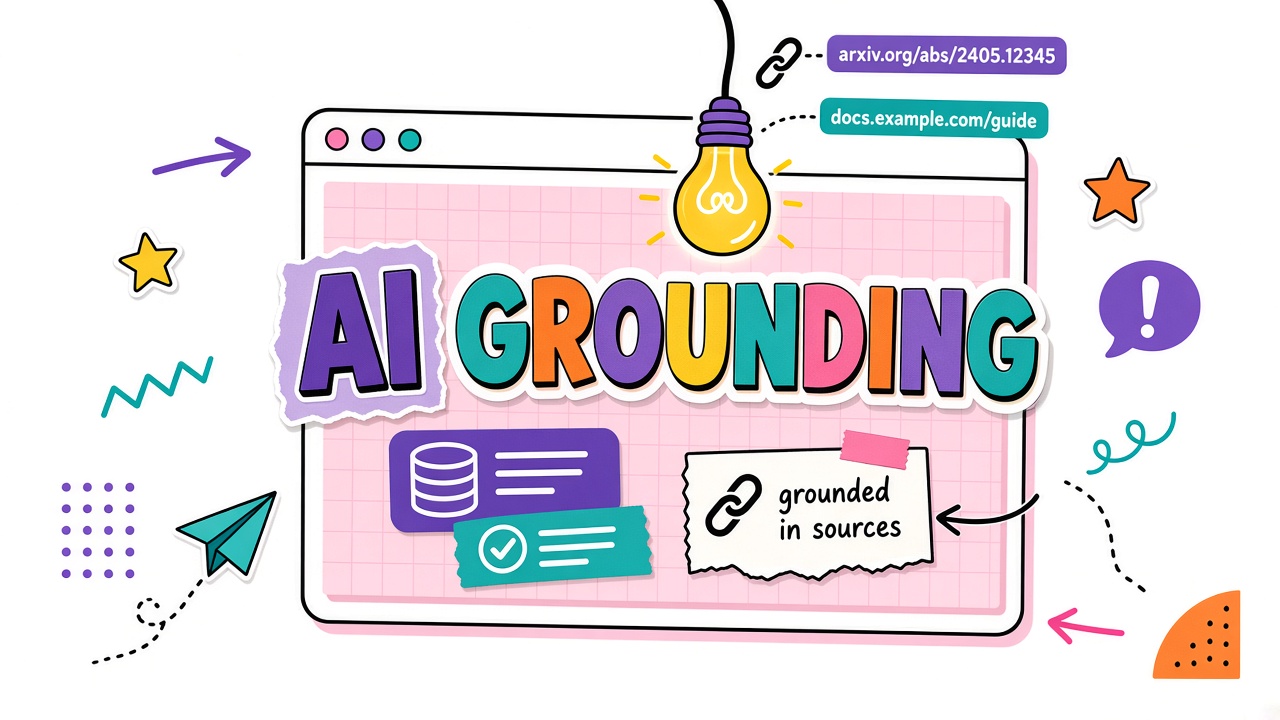
A research assistant cites three papers. You click the links. Two resolve correctly; one is a plausible title on a dead URL. The model sounded grounded because it wore the costume of citations. Real grounding in AI means outputs are tied to verifiable sources your tool can retrieve, quote, or trace, not merely formatted like an academic answer.
This guide defines grounding, compares retrieval grounding with live web grounding, shows how to judge citation quality, and lists product features to look for when evaluating AI research and AI chatbot tools. You will also learn when grounding fails silently and how grounding relates to RAG.
What Is Grounding in AI?
Grounding connects model-generated text to external evidence: documents in a knowledge base, uploaded files, database rows, API responses, or web pages fetched at query time. A grounded answer should let you verify claims by following citations back to the source material. Ungrounded answers rely on parametric memory inside the model weights, which can be fluent but stale or wrong.
Marketing terms vary: "grounded responses," "citations," "sources," "connected to your data," and "RAG-enabled" often describe overlapping architectures. The procurement question is always the same: can this tool show which evidence supported each sentence, and can you audit that evidence?
Retrieval Grounding vs Live Web Grounding
| Grounding type | Evidence source | Strengths | Weaknesses |
|---|---|---|---|
| Retrieval grounding (RAG) | Private docs, vector stores, enterprise KB | Controlled corpus, compliance-friendly boundaries | Stale indexes, chunking misses context |
| Live web grounding | Search APIs, fetched pages at query time | Fresh public facts, news, pricing pages | SEO spam, paywalls, incomplete fetches |
| Tool/API grounding | CRM, tickets, calendars, calculators | Structured truth for operational data | Integration cost, permission boundaries |
| User upload grounding | PDFs, spreadsheets in session | Immediate context for one-off analysis | Retention risk, large file parsing errors |
How to Judge Citation Quality
Use a simple rubric when reviewing AI citation accuracy in grounded tools:
- Resolvable: Link or document ID opens the cited passage.
- Specific: Citation points to a chunk or page, not a whole domain homepage.
- Supportive: Quoted text actually entails the claim (not adjacent topic).
- Current: Source date matches the freshness your decision requires.
- Complete: Material citations cover paywalled or missing docs honestly ("source not retrieved").
Score answers that fail two or more checks as ungrounded for high-stakes use, even if the prose sounds confident.
When Grounding Fails Silently
Common silent failure modes:
- Hallucinated citations: Real-looking URLs or DOIs that do not exist.
- Right source, wrong span: Retrieval returns a related paragraph that does not support the claim.
- Stale index: Internal KB not re-ingested after policy changes.
- Paywall gap: Snippet seen in search summary, full text never loaded.
- Over-trust in browse mode: Tool summarizes SEO pages without cross-checking.
AI research assistants should expose which chunks were retrieved. If the UI only shows a bibliography with no passage highlights, treat citations as decorative until proven.
Grounding Features to Look for in Tools
| Feature | Why it matters |
|---|---|
| Inline highlights with source spans | Lets reviewers verify each claim quickly |
| Corpus version and ingest timestamps | Explains stale answers after doc updates |
| "No source found" refusal mode | Reduces fabricated citations when retrieval is empty |
| Connector permissions per folder | Prevents cross-tenant leakage in enterprise search |
| Exportable audit log of retrieved chunks | Supports compliance reviews and incident response |
Grounding in Research and Knowledge Work
AI research assistants compete on grounding quality because academics and analysts cannot publish uncited claims. Strong products highlight passage-level quotes, link to DOI or internal doc IDs, and show retrieval confidence. Weak products paste a bibliography at the bottom with no connection between sentences and sources.
For internal knowledge bases, grounding depends on ingestion pipelines: OCR quality for scanned PDFs, chunk boundaries that split tables across segments, and permission filters so users only retrieve files they are allowed to see. A grounded answer from the wrong user's folder is both a privacy failure and a citation failure.
What buyers should verify in grounded chatbots
When AI grounding explained on a sales page sounds compelling, run three tests on your corpus: (1) ask a question whose answer exists only in a recently updated doc, (2) ask a trick question whose answer is not in the corpus, and (3) ask a question whose answer spans two chunks. Pass criteria: correct citation on (1), honest "not found" on (2), and merged evidence on (3). Repeat on AI chatbot candidates after each index refresh.
Grounding vs RAG
Retrieval-augmented generation (RAG) is an implementation pattern for grounding: retrieve relevant documents, inject them into context, generate an answer conditioned on those passages. Not all grounding is RAG (tool calls and SQL queries ground answers without vector search), and not all RAG is high-quality grounding (bad retrieval still produces bad citations). When vendors say "RAG," ask which retrieval model, chunk size, reranker, and citation formatter they use.
Frequently Asked Questions
Is grounding the same as RAG?
RAG is one grounding technique. Grounding is the outcome (answers tied to evidence); RAG is a common method to achieve it with document retrieval.
How do grounded tools handle paywalled sources?
Quality varies. Some tools cite abstracts only; others integrate licensed corpora; many hallucinate when full text is unavailable. Test with your paywalled subscriptions and require explicit "could not access full text" flags.
Does grounding eliminate hallucinations?
No. Grounding reduces but does not remove fabrication, especially when the model misreads a valid chunk or invents a citation string. Human review remains necessary for regulated decisions.
How does grounding differ on enterprise vs consumer tiers?
Enterprise products often add private corpus connectors, permission-aware retrieval, and audit logs. Consumer browse features may use public web only with shorter retention. Verify both retrieval scope and data handling, not just the "grounded" badge.
How should I test grounding before buying?
Build a gold-set of 20 to 30 questions with known answers in your documents. Measure citation resolvability, answer correctness, and stale-doc behavior after you update a source file. Repeat on chatbot candidates with grounding toggled on and off.
Building Trust in Grounded Responses
Grounded AI responses earn trust when users can click from claim to evidence in one action. Products that bury sources below the fold or show only domain names without snippets force users to treat answers like ungrounded chat. Train internal reviewers to spot "citation theater": correct-looking links that do not support the sentence above them.
Live web grounding introduces freshness benefits and spam risks. SEO pages optimized for crawlers may rank highly in retrieval while containing incorrect specs. Combine web grounding with allowlisted domains for high-stakes product facts, and fall back to internal KB for pricing and policy. Document the fallback order in runbooks so on-call engineers know which connector failed when answers go stale.
Grounding vs RAG with paywalled and licensed sources
Enterprise research tools license publishers; consumer browse tools may not. When paywalls block full text, grounded answers should say so explicitly rather than paraphrasing abstracts as if they were complete papers. Legal teams care because overconfident summaries of partial sources create liability similar to ungrounded hallucination.
Grounding Implementation Checklist for Teams
Step one: inventory authoritative sources (wiki, PDFs, tickets, CRM) and owners. Step two: define refresh SLAs per source type. Step three: configure chunking and metadata (title, date, product SKU). Step four: test retrieval with held-out questions weekly. Step five: monitor citation resolvability in production logs. Step six: train staff to distrust answers without clickable evidence on regulated topics.
Pair grounding with access control: retrieval must respect document permissions, not bypass them. Security reviews should treat grounded chat as a search index over sensitive files, not as casual brainstorming. When migrating vendors, re-embed corpora early; grounding quality drops during index lag even if chat UI looks unchanged.
Metrics for Grounding Quality Over Time
Track citation resolvability rate, answer accuracy on gold questions, stale-source rate after doc updates, and user-reported "wrong source" tickets. Segment metrics by corpus (internal wiki vs web vs tickets). Grounding regressions often follow ingestion failures rather than model downgrades; alert on index lag and OCR error spikes. Executive dashboards should show grounding health alongside model version, not replace it.
When what is grounding in AI initiatives stall, root causes are usually organizational: nobody owns corpus freshness, teams upload PDFs without titles, or permissions block retrieval for the users who need answers. Technology fixes alone cannot ground answers if source data is messy.
Grounding Architecture Patterns in Production
Pattern one: single-tenant vector index per customer for B2B SaaS, with metadata filters on account ID. Pattern two: federated search across wiki plus tickets plus CRM with unified reranking. Pattern three: web grounding limited to allowlisted domains plus internal KB fallback. Pattern four: tool-first grounding where SQL or API calls return authoritative numbers and the model only narrates results. Each pattern shifts failure modes: indexes go stale, APIs rate-limit, web fetches hit paywalls. Architecture reviews should pick patterns based on data sensitivity and freshness requirements, not because a vendor demo looked polished.
Operations runbooks should list ingestion owners, re-embed schedules, and escalation when citation rate drops below threshold. Grounding is as much data engineering as prompt engineering. Teams that treat it as a chat toggle without pipeline investment see hallucinations return whenever documents change faster than indexes.
Vendor Evaluation Workshop for Grounded AI
Run a half-day workshop with legal, support, and engineering: bring 25 real questions, two outdated docs, and one document that should not be retrievable due to permissions. Score vendors on accuracy, citation quality, permission respect, and honest "not found" behavior. Repeat quarterly because retrieval stacks change silently. Winners are vendors whose grounding degrades predictably and observably, not those with the flashiest demo on cherry-picked PDFs.
Long-term grounding programs need editorial calendars for source documents, not only engineering sprints for embeddings. Assign business owners to retire outdated pages, merge duplicates, and fix broken links in the knowledge base before blaming the model for wrong answers. Grounding quality is a function of corpus hygiene plus retrieval stack; neglect either side and citations will disappoint even on flagship models.
Does grounding slow down AI responses?
Retrieval and web fetch steps add latency before generation begins. Strong products cache frequent chunks and parallelize search, but grounded answers are usually slower than pure chat. Budget extra seconds in UX copy and SLA expectations for support bots that must cite sources.
How does grounding work across languages?
Multilingual grounding requires indexes in each language or cross-lingual embeddings. Citations may point to translated docs while the user question was in another language. Test retrieval per locale; do not assume English-indexed grounding serves global users.
Should we ground or fine-tune for company knowledge?
Grounding (RAG) is usually the first choice for factual company knowledge that changes frequently. Fine-tuning bakes patterns into weights and is harder to update when policies change weekly. Many teams use grounded retrieval for facts plus light fine-tuning or few-shot for tone and format. Evaluate cost of re-embedding vs retraining when your corpus churns quickly.
Schedule semiannual grounding drills: rotate who runs the gold question set, update expected answers when policies change, and compare results across model upgrades. Consistent drills catch silent retrieval regressions before customers do.
Pair grounding initiatives with document lifecycle owners so retired SKUs and expired policies disappear from indexes as quickly as they disappear from the public website. Stale grounding is a content problem before it is a model problem.
The Bottom Line
Grounding connects AI outputs to verifiable sources through retrieval, live web fetches, tools, or uploads. Judge tools by citation resolvability and passage support, not by how academic the answer looks. Expect silent failures from hallucinated links, stale indexes, and paywalls. Pilot with a labeled question set on research-oriented AI tools before trusting grounded claims in production workflows.