What is Voyager?
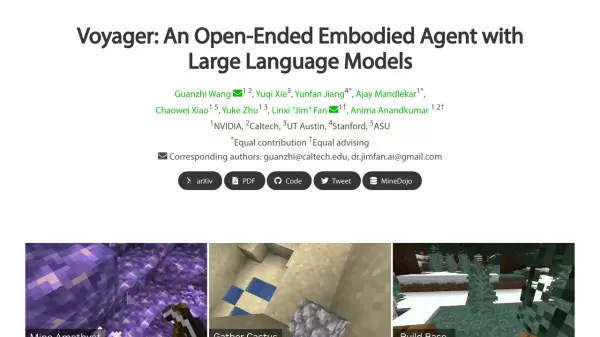
Voyager represents a significant advancement in AI gaming agents, utilizing GPT-4 to create an autonomous system that explores and masters Minecraft without human intervention. The system employs three innovative components: an automatic curriculum for exploration, a comprehensive skill library, and an iterative prompting mechanism that generates executable code for complex behaviors.
Through its sophisticated architecture, Voyager demonstrates exceptional performance metrics, obtaining 3.3x more unique items, covering 2.3x more terrain, and achieving tech tree milestones up to 15.3x faster than previous state-of-the-art solutions. Its ability to transfer learned skills to new environments and tackle novel challenges showcases its robust generalization capabilities.
Features
- Automatic Curriculum: Self-generates tasks based on exploration progress and agent state
- Skill Library: Stores and retrieves complex behaviors through code embedding
- Iterative Prompting: Incorporates environment feedback and self-verification for program improvement
- Zero-shot Generalization: Applies learned skills to new environments and tasks
- Continuous Learning: Progressively acquires and updates knowledge without human intervention
Use Cases
- Autonomous game exploration and mastery
- Virtual world navigation and discovery
- Complex task automation
- Skill development and transfer
- Self-directed learning systems
FAQs
-
What makes Voyager different from other Minecraft AI agents?
Voyager is unique because it combines GPT-4 with an automatic curriculum, skill library, and iterative prompting mechanism, allowing it to learn and explore continuously without human intervention, significantly outperforming other agents in exploration, tech tree progression, and skill transfer. -
How does Voyager's skill library work?
The skill library stores complex behaviors as executable code, indexed by description embeddings. When facing new tasks, it retrieves relevant skills through similarity matching and can compose multiple simpler programs to create more complex behaviors. -
What is the role of GPT-4 in Voyager?
GPT-4 serves as the core reasoning engine, generating executable code through prompting, creating automatic curriculums, and providing self-verification of task completion without requiring model parameter fine-tuning.