What is Sonar?
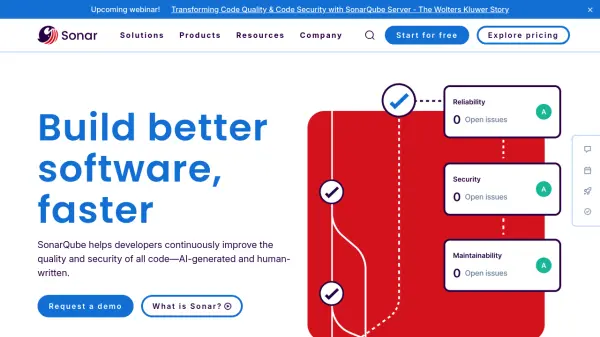
Sonar provides industry-leading solutions for static code analysis, enabling developers and organizations to build higher-quality and more secure software. It meticulously analyzes codebases, including both human-written and AI-generated code, to identify potential bugs, security vulnerabilities, code smells, and technical debt early in the development lifecycle. This proactive approach helps prevent issues from reaching production, ensuring software reliability and maintainability.
By integrating directly into developers' IDEs and CI/CD pipelines (supporting cloud and self-managed deployments), Sonar facilitates a 'Clean as You Code' methodology. It offers real-time feedback and actionable insights, empowering developers to fix problems as they arise. Sonar supports a wide range of programming languages and frameworks, providing comprehensive coverage for diverse technology stacks and helping organizations maintain compliance with security standards like the NIST Secure Software Development Framework.
Features
- Static Code Analysis: Identify bugs, vulnerabilities, and code smells in source code.
- AI Code Compatibility: Ensures quality and security standards for AI-generated code.
- Security Scanning (SAST & SCA): Detect security risks within code and open-source dependencies.
- Secrets Detection: Find hardcoded secrets within the codebase.
- IDE Integration (SonarQube for IDE): Provides on-the-fly analysis and coding guidance within the Integrated Development Environment.
- CI/CD Integration: Seamlessly integrates with DevOps pipelines (Cloud and Server options).
- Multi-Language Support: Analyzes code across 30+ programming languages and frameworks.
- Technical Debt Management: Helps track and reduce technical debt proactively.
- IaC Scanning: Analyzes Infrastructure as Code configurations for security and quality.
- Clean as You Code Methodology: Promotes fixing issues early in the development workflow.
Use Cases
- Improving code quality and maintainability.
- Enhancing application security posture (SAST, SCA).
- Ensuring quality of AI-generated code.
- Integrating security into DevOps (DevSecOps).
- Managing and reducing technical debt.
- Facilitating faster debugging with code coverage visibility.
- Enforcing coding standards across development teams.
- Meeting compliance requirements (e.g., NIST SSDF).
- Streamlining code reviews.
FAQs
-
What programming languages does Sonar support?
Sonar supports over 30 programming languages and frameworks, including popular ones like Java, JavaScript, TypeScript, Python, C#, C++, C, PHP, and Kotlin. A full list is available on their website. -
What are the different Sonar products?
Sonar offers SonarQube Cloud (cloud-based analysis for CI/CD), SonarQube Server (self-managed analysis for continuous inspection), and SonarQube for IDE (a free IDE extension for on-the-fly analysis). -
How does Sonar help with AI-generated code?
Sonar ensures that code generated by AI assistants meets high standards for quality and security, integrating checks into the development workflow. -
Does Sonar integrate with IDEs?
Yes, SonarQube for IDE is a free extension that integrates directly into Integrated Development Environments (IDEs) to provide real-time feedback as developers code. -
Can Sonar be used in a DevOps pipeline?
Yes, SonarQube Cloud and SonarQube Server are designed to integrate into CI/CD workflows and DevOps platforms to automate code quality and security checks.