What is ReactAgent?
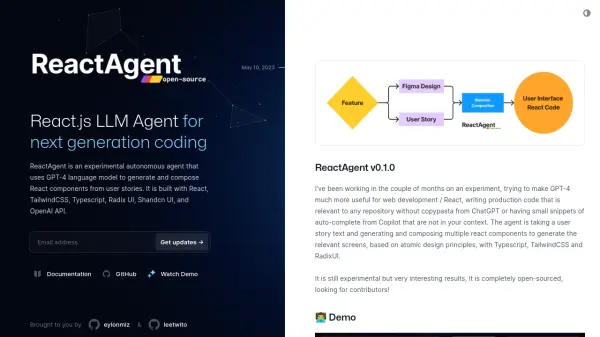
ReactAgent represents an innovative experimental autonomous agent that revolutionizes web development by utilizing GPT-4's language model capabilities. The tool specializes in generating and composing React components directly from user stories, implementing atomic design principles throughout the development process.
Built with a modern tech stack including React, TailwindCSS, Typescript, Radix UI, and Shandcn UI, this open-source tool provides developers with the ability to create production-ready code that seamlessly integrates into existing repositories. Unlike traditional copypasta solutions or limited auto-complete functionalities, ReactAgent generates contextually relevant, complete components.
Features
- Component Generation: Generates React Components from user stories
- Component Composition: Composes React Components from existing components
- Design System Integration: Uses local design system for component generation
- Modern Tech Stack: Built with React, TailwindCSS, Typescript, Radix UI, Shandcn UI
- Atomic Design: Implements Atomic Design Principles
Use Cases
- Rapid React component development
- Automated UI generation from user requirements
- Design system implementation
- Production code generation
- Web application prototyping
FAQs
-
What technology stack does ReactAgent use?
ReactAgent uses React, TailwindCSS, Typescript, Radix UI, and Shandcn UI as its primary technology stack. -
Is ReactAgent open source?
Yes, ReactAgent is completely open-source and looking for contributors. -
What AI model powers ReactAgent?
ReactAgent uses the GPT-4 language model from OpenAI.