What is OpenFaaS?
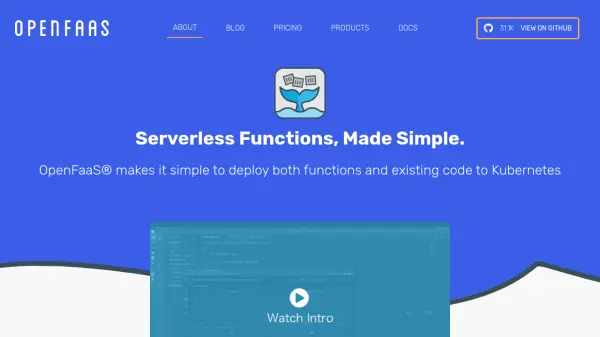
OpenFaaS provides a powerful platform for deploying serverless functions and existing microservices to Kubernetes clusters both on-premises and in the cloud. The platform is designed for simplicity and flexibility, allowing users to write functions in any programming language utilizing pre-built templates or their own custom templates, and deploy them as portable container images. With support for event-driven workloads, autoscaling (including scaling to zero), advanced monitoring, and seamless integration with popular messaging systems like Kafka, GCP Pub/Sub, and AWS SQS/SNS, OpenFaaS is well-suited to handling production workloads at any scale.
OpenFaaS offers tiered solutions including a free Community Edition for personal or experimental use, a Standard plan for production-ready deployments, and an Enterprise plan with enhanced features such as multi-tenancy, Single Sign-On, RBAC, audit capabilities, and premium support. It is trusted by leading organizations for use cases ranging from ETL pipelines to multi-tenant SaaS platforms, facilitating faster feature releases and efficient Kubernetes management for both developers and enterprises.
Features
- Multi-Language Support: Write functions in any programming language using pre-built or custom templates.
- Portable Deployments: Deploy serverless functions in containers to any Kubernetes cluster, both on-premises and in the cloud.
- Autoscaling: Scale functions automatically including to zero, based on demand and custom metrics.
- Event-Driven Triggers: Support for invoking functions via events from Kafka, AWS SQS/SNS, GCP Pub/Sub, RabbitMQ, Postgresql, Cron, and MQTT.
- Production-Ready Management: Includes RBAC, Single Sign-On, advanced dashboards, and fine-tuned scaling options in Pro and Enterprise editions.
- Monitoring & Observability: Grafana dashboards for metrics, function health, retries, and concurrency.
- REST API Management: Manage functions, secrets, logs, and namespaces via a robust RESTful API.
- Multi-Tenancy: Secure namespace isolation and resource limits for enterprise environments.
Use Cases
- Deploying serverless functions in Kubernetes environments
- Building scalable microservices architectures
- Running ETL and data pipelines with automatic scaling
- Enabling customer extensibility or sandboxed function execution in SaaS products
- Integrating event-driven processing with message queues and schedules
- Batch job automation and ML model deployment
FAQs
-
What programming languages are supported for writing functions in OpenFaaS?
OpenFaaS functions can be written in any programming language with official templates available for Go, Java, Python, C#, Ruby, Node.js, PHP, and users can also create their own templates. -
Can OpenFaaS be deployed both on-premises and in the cloud?
Yes, OpenFaaS supports deployment to any Kubernetes cluster, either on-premises or in the cloud, providing a unified experience regardless of infrastructure. -
Does OpenFaaS offer multi-tenancy and secure isolation for enterprise use?
Yes, OpenFaaS Enterprise supports multi-tenancy, secure function isolation, dedicated namespaces, and RBAC policies for enterprise deployments. -
How does OpenFaaS handle autoscaling?
OpenFaaS features fine-tuned autoscaling, including the ability to scale functions to zero during idle periods and scale up based on custom metrics such as RPS, CPU, or capacity. -
Is OpenFaaS suitable for production workloads?
OpenFaaS Standard and Enterprise editions are designed for production use, with enhanced features, support, and robust management tools for critical workloads.