What is Market Brew?
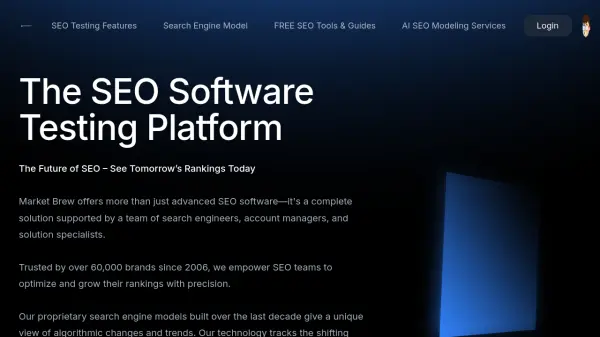
Market Brew offers more than just advanced SEO software—it's a complete solution supported by a team of search engineers, account managers, and solution specialists. Trusted by over 60,000 brands since 2006, Market Brew empowers SEO teams to optimize and grow their rankings with precision.
Proprietary search engine models built over the last decade give a unique view of algorithmic changes and trends. This technology tracks the shifting patterns in search engine algorithms, allowing for proactive strategy adjustments before they impact rankings. Market Brew prioritizes the optimizations that matter most and guides teams through execution, enabling forecasting of search engine rankings and achieving sustainable growth.
Features
- Calibrated Algorithms: Search engine models that can calibrate settings using machine learning to behave like any search engine.
- Predict Rankings: Test website changes in the model and immediately predict SEO rankings.
- Transparent: Expose ranking factors and see exactly why one webpage was selected over another.
- Accurate: Utilizes a genetic algorithm to calibrate each search engine model.
- Intelligent: Advanced SEO testing platform optimized for speed and efficiency.
- Predictive: Make and test optimizations, and forecast SEO rankings, typically more than 60 days ahead of industry-leading rank trackers.
Use Cases
- Predicting the impact of website changes on SEO rankings.
- Identifying and prioritizing SEO optimization tasks.
- Understanding search engine algorithm changes and trends.
- Analyzing competitor strategies and identifying opportunities.
- Testing SEO strategies before implementation.
- Enterprise SEO management.
FAQs
-
What are the Top Features of SEO Software Currently on the Market?
Top features include keyword research and analysis, on-page optimization, backlink analysis, site auditing, rank tracking, social media integration, reporting and analytics, cloud-based and mobile optimization, collaboration and white-label reporting, and integration with other tools and platforms. -
What Makes the Best SEO Software?
The best SEO software provides a comprehensive set of features, improves search engine rankings, has a user-friendly interface, provides accurate and up-to-date data and analysis, and adapts to the changing landscape of search engines and digital marketing. -
How Leading SEO Software Platforms Offer Competitor Research?
Leading SEO software offers a comprehensive solution for competitor analysis, including tracking competitors' websites, analyzing keywords and backlinks, and providing a holistic view of the competitive landscape to identify gaps and opportunities.