marimo favicon

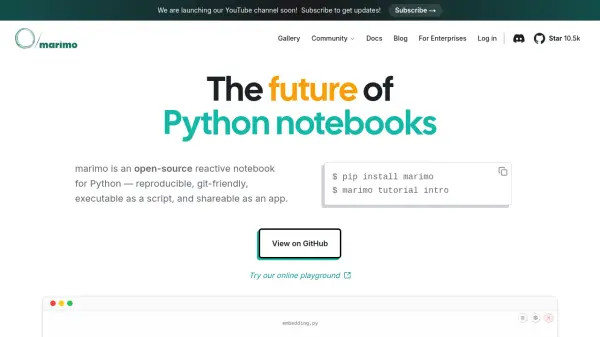
marimo
The future of Python notebooks

What is marimo?

marimo is an open-source reactive notebook designed for Python. It enables reproducible workflows, seamless collaboration with git, and versatile deployment options as either scripts or web applications.

This tool enhances the traditional notebook experience with automatic updates to outputs and interactive UI elements, offering a more dynamic and intuitive way to work with data and code. marimo prioritizes a Python-first design, ensuring notebooks are stored as pure .py files, compatible with standard version control and development tools.

Features

  • Reactive Execution: Outputs update automatically when code or related cells are modified.
  • Interactive Elements: Incorporates UI elements like dataframe GUIs and plots for interactive data exploration.
  • Reproducible: Notebooks are executed in a deterministic order with no hidden state.
  • Git-Friendly: Notebooks are stored as .py files, making them easy to version control with git.
  • Deployable: Can be run as Python scripts or deployed as read-only web apps.
  • Python-First Design: Pure Python notebooks, compatible with existing Python tools and workflows.

Use Cases

  • Computational experiments and data exploration
  • Sharing and communicating research findings
  • Creating interactive educational applications
  • Building generative AI applications
  • Developing and deploying internal tools

FAQs

  • How does marimo differ from Jupyter Notebooks?
    marimo provides reactive execution, meaning outputs update automatically as code changes, and it stores notebooks as pure Python (.py) files, enhancing reproducibility and git compatibility, unlike Jupyter's JSON-based .ipynb files.

Helpful for people in the following professions

Blogs:

  • Top AI tools for Students

    Top AI tools for Students

    These AI tools are designed to enhance the learning experience for students. From personalized study plans to intelligent tutoring systems.

  • Best AI tools for Product Photography

    Best AI tools for Product Photography

    Explore top AI tools that can elevate your product photography, helping you enhance images, streamline workflows, and create professional visuals with ease.

  • Best AI tools for recruiters

    Best AI tools for recruiters

    These tools use advanced algorithms and machine learning to automate tasks such as resume screening, candidate matching, and predictive analytics. By analyzing vast amounts of data quickly and efficiently, AI tools help recruiters make data-driven decisions, save time, and identify the best candidates for open positions.

  • Top 6 AI note-taking tools for 2026: in-person, online, and hybrid use cases

    Top 6 AI note-taking tools for 2026: in-person, online, and hybrid use cases

    Most AI note-taking lists are really lists of meeting bots, which join your video call and transcribe it. That's useful, but it's half the picture. Decisions happen in hallway conversations, client dinners, on-site visits, and hybrid rooms where nobody is on a video link. This guide covers different parts of the note-taking workflow: hardware capture for in-person settings, platform-native tools for online calls, and AI layers for organizing and synthesizing what you've captured. It compares six tools by capture context, workflow fit, pricing, and limitations.

Didn't find tool you were looking for?

Be as detailed as possible for better results