What is Kogno?
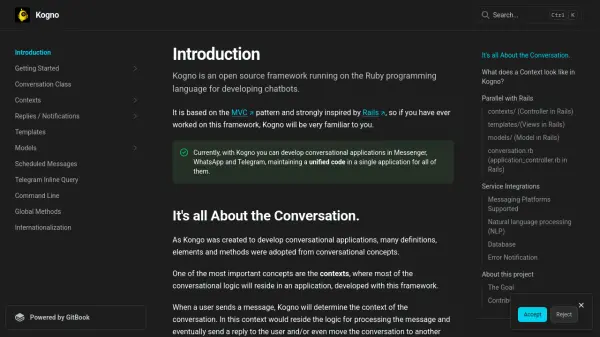
Kogno is an open-source framework built on the Ruby programming language, specifically designed for creating chatbots. It draws inspiration from the MVC pattern, particularly the Rails framework, offering a familiar structure for developers experienced with Rails. Kogno enables the development of conversational applications that can operate across multiple messaging platforms, including Messenger, WhatsApp, and Telegram, using a unified codebase.
The framework centers around the concept of "contexts," which manage the conversational logic. When a user sends a message, Kogno determines the appropriate context to process the input and generate a response. Contexts contain various "blocks" to handle different types of user input, such as intents recognized by NLP, specific keywords, postback events, or fallback scenarios. Kogno also supports templating using .erb files for crafting replies and integrates with databases via ActiveRecord for user data management.
Features
- Open Source Framework: Built with Ruby for chatbot development.
- Multi-Platform Support: Develop unified code for Messenger, WhatsApp, and Telegram.
- MVC-Inspired Architecture: Utilizes contexts (controllers), templates (views), and models.
- NLP Integration: Connects with NLP engines like Wit.ai for intent recognition.
- Context-Based Logic: Manages conversation flow through contexts and blocks (intent, keyword, postback, etc.).
- Templating System: Uses .erb files for dynamic reply generation.
- Database Integration: Leverages ActiveRecord for model management and interaction.
- Variety of Reply Types: Supports text, buttons, quick replies, images, video, lists, carousels, and more.
Use Cases
- Developing chatbots for customer support across multiple platforms.
- Creating conversational applications for specific business processes.
- Building automated responders for Messenger, WhatsApp, and Telegram.
- Implementing NLP-powered conversational interfaces.
- Developing Ruby-based chatbot projects with a structured framework.
FAQs
-
What programming language does Kogno use?
Kogno runs on the Ruby programming language. -
Which messaging platforms does Kogno support?
Kogno currently supports Messenger, WhatsApp, and Telegram. -
Is Kogno inspired by any other frameworks?
Yes, Kogno is strongly inspired by the Ruby on Rails framework and the MVC pattern. -
Does Kogno support Natural Language Processing (NLP)?
Yes, Kogno integrates with NLP engines like Wit.ai. -
What database ORM does Kogno use?
Kogno uses the ActiveRecord library for database interaction, similar to Rails.