GGML
AI at the Edge

What is GGML?

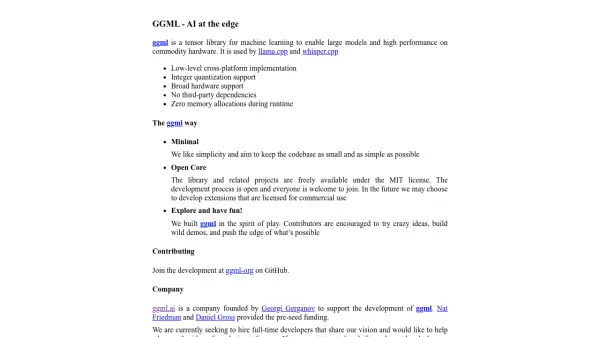
GGML is a tensor library specifically crafted for machine learning applications. Its primary focus is to enable the execution of large models with high performance on readily available, commodity hardware. This is achieved through a low-level, cross-platform implementation and features such as integer quantization support. The library is designed to be self-contained, with no third-party dependencies and zero memory allocations during runtime, contributing to its efficiency and speed.

GGML is utilized by projects such as llama.cpp and whisper.cpp. The development of GGML emphasizes simplicity, maintaining a minimal and easy-to-understand codebase. It operates under an open-core model, with the library and associated projects freely available under the MIT license.

Features

  • Low-level cross-platform implementation: Enables broad hardware compatibility.
  • Integer quantization support: Optimizes model size and performance.
  • Broad hardware support: Runs efficiently on commodity hardware.
  • No third-party dependencies: Simplifies integration and reduces potential conflicts.
  • Zero memory allocations during runtime: Enhances performance and stability.

Use Cases

  • On-device inference
  • Machine learning applications on edge devices
  • Deployment of large language models on commodity hardware
  • Development of AI applications with limited resources

Related Tools:

Blogs:

  • Best AI tools for Room Design

    Best AI tools for Room Design

    Discover cutting-edge AI tools that redefine the art of room design. From layout optimization to aesthetic finesse, these top-tier tools enhance your space to new heights.

  • Best Content Automation AI tools

    Best Content Automation AI tools

    Streamline your content creation process, enhance productivity, and elevate the quality of your output effortlessly. Harness the power of cutting-edge automation technology for unparalleled results

  • Top 6 AI note-taking tools for 2026: in-person, online, and hybrid use cases

    Top 6 AI note-taking tools for 2026: in-person, online, and hybrid use cases

    Most AI note-taking lists are really lists of meeting bots, which join your video call and transcribe it. That's useful, but it's half the picture. Decisions happen in hallway conversations, client dinners, on-site visits, and hybrid rooms where nobody is on a video link. This guide covers different parts of the note-taking workflow: hardware capture for in-person settings, platform-native tools for online calls, and AI layers for organizing and synthesizing what you've captured. It compares six tools by capture context, workflow fit, pricing, and limitations.

Didn't find tool you were looking for?

Be as detailed as possible for better results