What is FFlags?
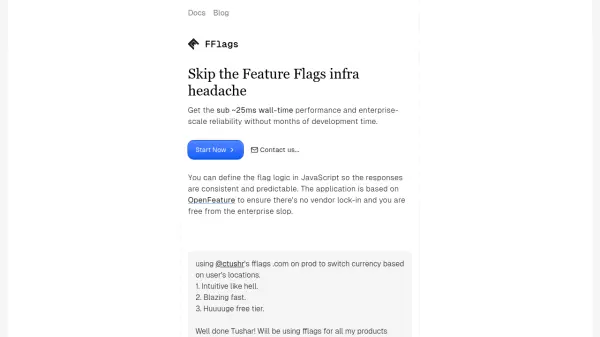
FFlags is a feature flag management platform designed to simplify infrastructure for developers. It leverages AI to provide sub-25ms wall-time performance and enterprise-scale reliability, eliminating the need for months of development effort. The platform allows users to define flag logic in JavaScript, ensuring consistent and predictable responses while maintaining compatibility with OpenFeature standards to prevent vendor lock-in.
The application utilizes the Edge Network for high availability, making it suitable for global deployments. With a usage-based pricing model, FFlags offers unlimited flags and users, charging $39 per million requests. This approach enables developers to implement complex feature flagging strategies efficiently and cost-effectively.
Features
- Feature Flag as Code: Define flags in code using JavaScript or TypeScript for complex logic and full language power
- OpenFeature Compliant: Ensures no vendor lock-in and adherence to industry standards for interoperability
- Edge Network Deployment: Uses Edge Network for high availability and global application support
- Performance Optimization: Delivers sub-25ms wall-time performance for fast flag evaluations
- Usage-Based Pricing: Charges $39 per million requests with no limits on flags or users
Use Cases
- A/B testing new features in production applications
- Gradual feature rollouts to specific user segments
- Geographic-based feature deployment (e.g., currency switching by location)
- Emergency feature toggling during incidents or bugs
- Canary releases for testing features with limited user groups
FAQs
-
What is the pricing model for FFlags?
FFlags uses a usage-based pricing model where you pay $39 per million requests, with no limits on the number of flags or users. -
How does FFlags ensure high availability?
FFlags uses the Edge Network to serve feature flags, making it highly available and suitable for global applications. -
What programming languages can I use to define feature flags?
You can define feature flag logic in JavaScript, allowing you to use the full power of TypeScript for complex flag definitions. -
Is there vendor lock-in with FFlags?
No, FFlags is based on OpenFeature to ensure there's no vendor lock-in and you maintain flexibility. -
What is the performance benchmark for FFlags?
FFlags delivers sub-25ms wall-time performance for feature flag evaluations.