Chainer favicon

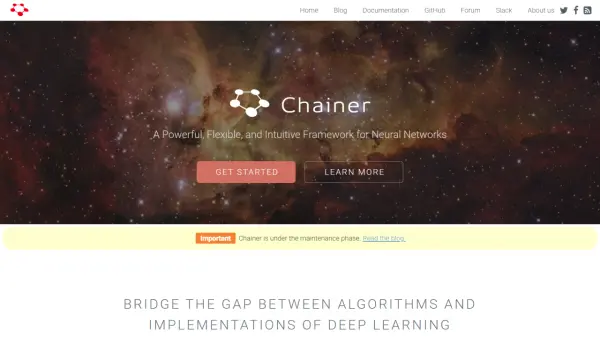
Chainer
A Powerful, Flexible, and Intuitive Framework for Neural Networks

What is Chainer?

Chainer is a pioneering deep learning framework designed to bridge the gap between algorithms and implementations of neural networks. It offers native CUDA support for GPU computation, requiring minimal code adjustments to leverage hardware acceleration and multi-GPU capabilities.

The framework stands out for its flexible architecture, supporting various neural network types including feed-forward, convolutional, recurrent, and recursive networks. What makes Chainer particularly unique is its intuitive approach to forward computation, allowing developers to use standard Python control flow statements while maintaining full backpropagation capabilities.

Features

  • CUDA Support: Native GPU acceleration with minimal code requirements
  • Multiple GPU Support: Easy scaling across multiple GPUs
  • Flexible Architecture: Support for various neural network types
  • Python Integration: Native Python control flow support
  • Backpropagation: Automatic differentiation while maintaining Python dynamics
  • Per-batch Architecture Support: Flexible batch processing capabilities

Use Cases

  • Deep learning research and development
  • Computer vision applications
  • Neural network training and deployment
  • Deep reinforcement learning
  • Machine learning education and training

FAQs

  • Is Chainer actively maintained?
    Chainer is currently under the maintenance phase, as stated in their blog.
  • How do I install Chainer?
    Chainer can be installed using pip with the command: pip install chainer

Helpful for people in the following professions

Related Tools:

Blogs:

  • Best AI tools for trip planning

    Best AI tools for trip planning

    These tools analyze user preferences, budget constraints, and destination details to provide personalized itineraries, suggest optimal routes, recommend accommodations, and even offer real-time updates on weather and local events.

  • Top 6 AI note-taking tools for 2026: in-person, online, and hybrid use cases

    Top 6 AI note-taking tools for 2026: in-person, online, and hybrid use cases

    Most AI note-taking lists are really lists of meeting bots, which join your video call and transcribe it. That's useful, but it's half the picture. Decisions happen in hallway conversations, client dinners, on-site visits, and hybrid rooms where nobody is on a video link. This guide covers different parts of the note-taking workflow: hardware capture for in-person settings, platform-native tools for online calls, and AI layers for organizing and synthesizing what you've captured. It compares six tools by capture context, workflow fit, pricing, and limitations.

  • Best text to speech AI tools

    Best text to speech AI tools

    Text-to-speech (TTS) AI tools are designed to convert written or text-based content into natural-sounding spoken audio. These tools utilize various deep learning and neural network architectures to generate human-like speech from textual input.

Didn't find tool you were looking for?

Be as detailed as possible for better results