What is CEBRA?
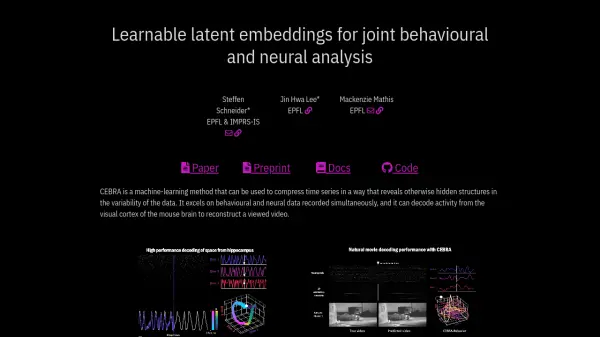
CEBRA is a machine-learning method designed to compress time-series data in a way that uncovers hidden structures within the data's variability. It is particularly effective when applied to behavioral and neural data that have been recorded simultaneously.
One notable application of CEBRA is its ability to decode activity from the visual cortex of a mouse brain and reconstruct a viewed video. This demonstrates the tool's capability to process complex biological data and extract meaningful, interpretable information.
Features
- Supervised Hypothesis-Driven Learning: Uses behavioral and neural data to produce consistent, high-performance latent spaces.
- Self-Supervised Discovery-Driven Learning: Can operate in a label-free manner for exploratory analysis.
- High-Accuracy Decoding: Capable of decoding latent spaces to reveal underlying correlates of behavior, including reconstructing videos from visual cortex activity.
- Cross-Species and Data Type Compatibility: Validated for use with both calcium and electrophysiology datasets, across sensory and motor tasks, and in simple or complex behaviors across species.
- Multi-Session Data Handling: Allows for single and multi-session datasets to be leveraged for hypothesis testing.
Use Cases
- Mapping behavioral actions to neural activity.
- Modeling neural dynamics during adaptive behaviors.
- Uncovering neural representations.
- Decoding neural activity to understand underlying correlates of behavior.
- Mapping of space and uncovering complex kinematic features.
- Rapid decoding of natural movies from visual cortex.