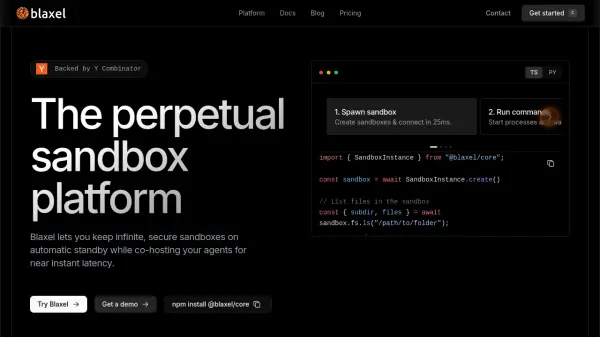
What is Blaxel?
Blaxel offers a serverless computing platform specifically designed for AI builders, simplifying the process of developing, deploying, and scaling AI agents. It provides a comprehensive toolbox and robust infrastructure, eliminating the need for builders to manage complex underlying systems. The platform supports development in Python or TypeScript and integrates seamlessly with GitHub for automated deployments, requiring zero configuration to get started.
Featuring cloud-hosted MCP (Managed Compute Platform) servers, Blaxel allows for asynchronous tool calls, offering both pre-built and custom server options. Its unified AI gateway grants access to numerous LLMs from leading providers and supports routing to self-hosted models, complete with access control and usage limits. Additionally, Blaxel incorporates embedded LLM observability based on OpenTelemetry, providing detailed metrics, logs, and traces for enhanced monitoring and debugging of AI applications and agent runs.
Features
- Serverless Platform: Develop and deploy agents efficiently without managing infrastructure.
- Framework-Agnostic Development: Build agents using Python or TypeScript.
- GitHub Integration: Sync repositories for automated deployment.
- Cloud-Hosted MCP Servers: Run asynchronous tool calls with pre-built or custom servers.
- Unified AI Gateway: Access various LLMs (OpenAI, Anthropic, Cohere, etc.) or self-hosted models via a single gateway.
- Embedded LLM Observability: Monitor metrics, logs, and traces for LLM applications and agent runs (OpenTelemetry-based).
- Sandboxed VMs: Securely run AI-generated code in isolated, stateful virtual machines with low latency boot times.
- Scalable Compute Resources: Access agent-native VMs with ultra-low latency, scaling down to zero.
- Global Agentics Network: Production-grade network built for connecting agentic AI workloads.
Use Cases
- Developing and deploying AI agents without managing server infrastructure.
- Building applications requiring asynchronous tool calls (e.g., web search, database access).
- Managing access and costs for multiple Large Language Models (LLMs).
- Monitoring and debugging complex AI agent workflows.
- Running code generation agents securely in isolated environments.
- Scaling AI agent workloads efficiently.
- Automating cloud operations using AI agents.