What is Authorizer?
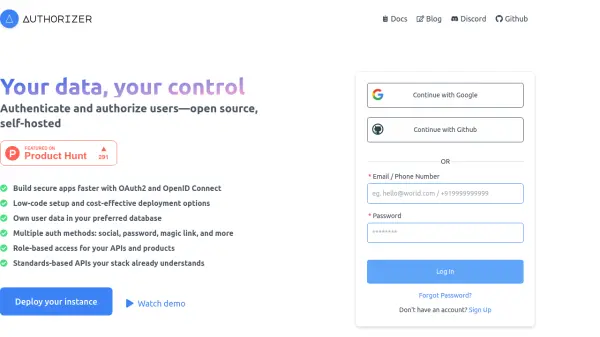
Authorizer is an open-source authentication and authorization platform designed for developers who prioritize data control and compliance. It enables self-hosted deployment on your cloud or VPC, ensuring user data resides in your database—whether SQL, NoSQL, or graph-based—rather than with third-party vendors. The platform supports standards like OAuth2 and OpenID Connect for seamless integration with existing tech stacks.
With features such as social login, password-based authentication, magic links, and role-based access control, Authorizer simplifies secure session management. It offers low-code setup, customizable email templates, webhook event listeners, and multi-factor authentication. The v2 roadmap focuses on enterprise enhancements like rate limiting, audit logs, and B2B automation, making it a practical choice for teams needing ownership and cost predictability without sacrificing functionality.
Features
- Self-Hosted Deployment: Deploy on your cloud or VPC with full control over infrastructure and data residency.
- Database Flexibility: Supports 11+ databases including SQL, NoSQL, and graph databases for user data storage.
- Multiple Authentication Methods: Offers social login, password-based auth, magic links, and multi-factor authentication.
- Role-Based Access Control: Define roles and authorize APIs with session tokens for secure access management.
- Standards-Based APIs: Built on OAuth2 and OpenID Connect for predictable integration across tech stacks.
Use Cases
- Building secure applications with self-hosted authentication to meet data residency requirements.
- Integrating role-based access control for APIs and products in private networks.
- Deploying cost-effective authentication solutions without per-seat pricing models.
- Managing user directories in existing databases for compliance and data silo reduction.
- Implementing multi-factor authentication and custom email templates for enhanced security.
FAQs
-
What databases does Authorizer support?
Authorizer supports 11+ databases, including major SQL, NoSQL, and graph databases, allowing user data storage in your preferred system. -
Can I deploy Authorizer on my own infrastructure?
Yes, Authorizer is self-hosted and can be deployed on your cloud, VPC, or using options like Railway, Heroku, Render, Docker, and Kubernetes. -
Does Authorizer offer multi-factor authentication?
Yes, it includes email-based OTP for basic authentication recipes as an added security layer. -
Is there a React SDK available for Authorizer?
Yes, Authorizer provides a React SDK for embedding UI and building custom interfaces in JavaScript or React frameworks. -
What are the key features in the v2 roadmap?
The v2 roadmap focuses on security hardening, audit logs, Prometheus metrics, machine-to-machine auth, API keys, and directory sync (SCIM).